How to Get a Business Loan to Buy an Existing Business in the UK
Buying an established business can fast-track your path into ownership. You inherit customers, systems, and revenue from day one. But here’s the sticking point most buyers face: funding the purchase without overstretching themselves.
If you’re searching for business loans for buying a business, you need more than theory. You need clear steps, realistic expectations, and practical detail you can act on.
Let’s get straight into what actually works.
Can You Get a Business Loan to Buy a Business?
Yes, UK lenders do fund business acquisitions. But approval depends less on your idea and more on the numbers of the business you’re buying.
In simple terms, lenders ask one core question:
Can this business comfortably repay the loan after you take over?
To answer that, they focus on:
- At least 2 years of trading history
- Stable or growing profit (not just revenue)
- Clean financial records
- Your ability to manage or improve the business
If the business is loss-making or unstable, getting a buying a business loan UK becomes difficult unless you bring in a large deposit.
What Lenders Expect
This is where many guides stay vague. Let’s be specific.
Most lenders in the UK expect:
- Deposit: 10% to 30% of the purchase price
- Loan size: £25,000 to £2 million+ depending on security
- Repayment term: 3 to 10 years
- Interest rates: Typically 6% to 15% (varies based on risk)
Example:
You want to buy a business for £200,000
- Your deposit: £40,000 (20%)
- Loan required: £160,000
If the business generates £60,000 annual profit, lenders will check if repayments (roughly £2,000 to £3,000 per month) are manageable after expenses.
Also Read – Best Low Interest Business Loans in the UK for Startups
Types of Business Loans That Actually Work for Acquisitions
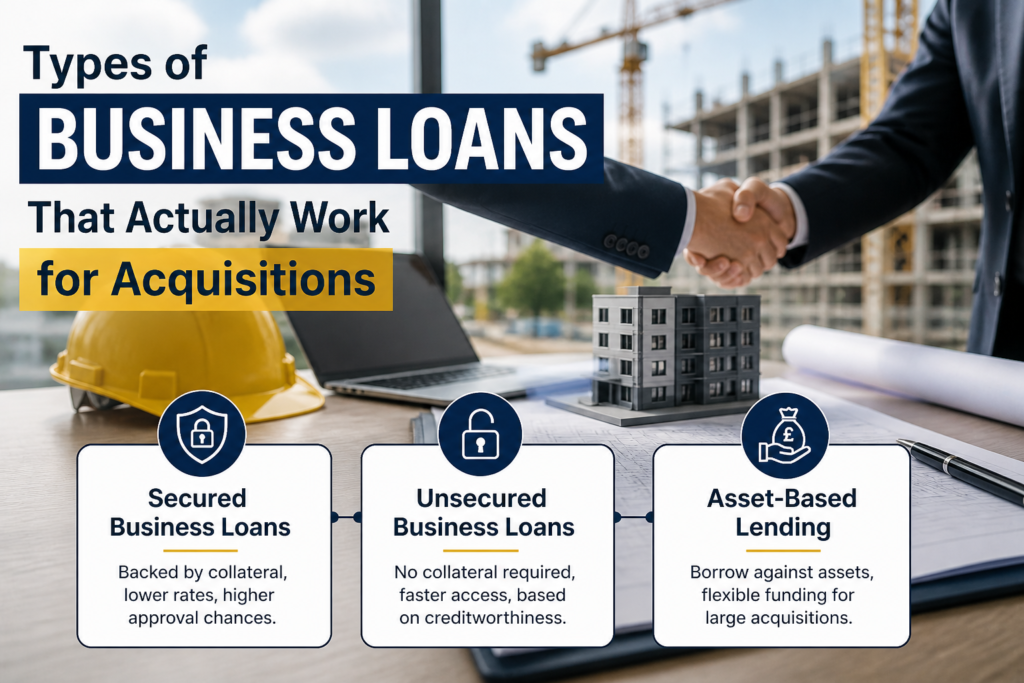
Secured Business Loans
Best suited for larger purchases.
- Backed by property or assets
- Lower interest rates
- Higher approval chances
If you own property, secured business loans uk are often the most cost-effective route.
Unsecured Business Loans
Useful when you don’t want to risk assets.
- No collateral required
- Faster decisions
- Higher interest rates
These are commonly used for smaller deals under £250,000.
Asset-Based Lending
Here, the lender uses the business’s assets as security.
Practical example:
If you’re buying a manufacturing business with equipment worth £100,000, part of your loan can be secured against that equipment.
Working Capital Support After Purchase
Many buyers focus only on the purchase price and run into trouble later.
You may need extra funding for:
- Staff wages
- Supplier payments
- Tax bills
A revolving credit facility uk can help manage these ongoing costs without taking a new loan every time.
Step-by-Step: How to Get a Business Loan to Buy a Business
Step 1: Check the Business Financials Properly
Do not rely on surface-level numbers.
Ask for:
- Profit and loss statements (last 2 to 3 years)
- Bank statements
- Tax returns
- List of debts and liabilities
Practical tip:
If profit drops sharply in the most recent year, ask why. Lenders will.
Step 2: Confirm the Real Value of the Business
Sellers often price businesses based on expectations, not reality.
A common valuation method:
- 2x to 4x annual profit (depending on industry)
Example:
If profit is £50,000, a reasonable valuation may fall between £100,000 and £200,000.
Overpaying makes loan approval harder because the deal looks risky.
Step 3: Build a Focused Business Plan
This doesn’t need to be long. It needs to be clear.
Include:
- What the business does
- Current performance
- What you will improve
- How you will increase profit
- How the loan will be repaid
Keep it practical. Avoid vague claims like “I will grow the business online” without explaining how.
Step 4: Calculate Your Total Funding Requirement
Don’t stop at the purchase price.
Add:
- Legal fees (£2,000 to £5,000 typical)
- Accountant or due diligence costs
- Working capital (at least 3 months of expenses)
If the business has upcoming VAT or tax liabilities, short-term solutions like vat bridging loans can prevent cash flow pressure.
Step 5: Choose the Right Lender
Different lenders suit different situations.
- High street banks: lower rates, stricter checks
- Alternative lenders: faster, more flexible
- Specialist providers: better for complex deals
Working with best business finance lenders or a broker can help match your case with the right funding option quickly.
Step 6: Submit a Strong Application
A solid application includes:
- Personal credit profile
- Business financials
- Purchase agreement
- Business plan
Incomplete applications are one of the most common reasons for delays or rejections.
Also Read – Low Interest Government Business Loans for Small Businesses
How to Compare Interest Rates Properly
Don’t just look at the percentage.
Focus on:
- Total repayment cost over the loan term
- Monthly affordability
- Fees (arrangement, legal, early repayment)
- Flexibility in repayments
Example:
A 7% loan with rigid terms may cost you more stress than a 9% loan with flexible repayments.
Common Mistakes That Cost Buyers Money

These are easy to avoid if you know them early:
- Buying based on revenue instead of profit
- Not keeping a cash buffer after purchase
- Ignoring existing debts in the business
- Rushing into the first loan offer
A business can look profitable on paper but still struggle with cash flow. Lenders check both. You should too.
Final Thoughts
Getting a loan to buy a business in the UK is less about luck and more about preparation.
Strong numbers, a realistic plan, and choosing the right lender make all the difference. When everything lines up, funding becomes a tool, not a barrier.
If you’re serious about acquiring a business, start by reviewing real financials and understanding how much you can safely borrow. From there, the right funding option becomes much clearer.
FAQs
- Can you get a business loan to buy a business in the UK?
Yes. Many lenders offer small business loans to buy a business, provided the business has stable financials and you meet lending criteria.
- How much deposit do I need?
Most lenders require 10% to 30% of the purchase price, depending on risk and loan type.
- How long does it take to get approved?
Ans. Alternative lenders may approve within a few days. Banks can take 2 to 6 weeks.
- Can I use the business assets as security?
Yes. In many cases, equipment, stock, or invoices can support asset-based lending.
- What if the business has tax liabilities?
You’ll need to account for them in your funding plan. Short-term options like bridging finance can help manage immediate payments such as VAT or corporation tax.
Discover the Latest Trends
Stay informed with our latest articles and resources.